Trackers Mounts & Filters
Explore 5 fascinating articles about trackers mounts & filters
Stabilize and filter your view. A deep dive into star trackers, equatorial mounts, and light pollution filters for advanced astrophotography.
All Articles (5)
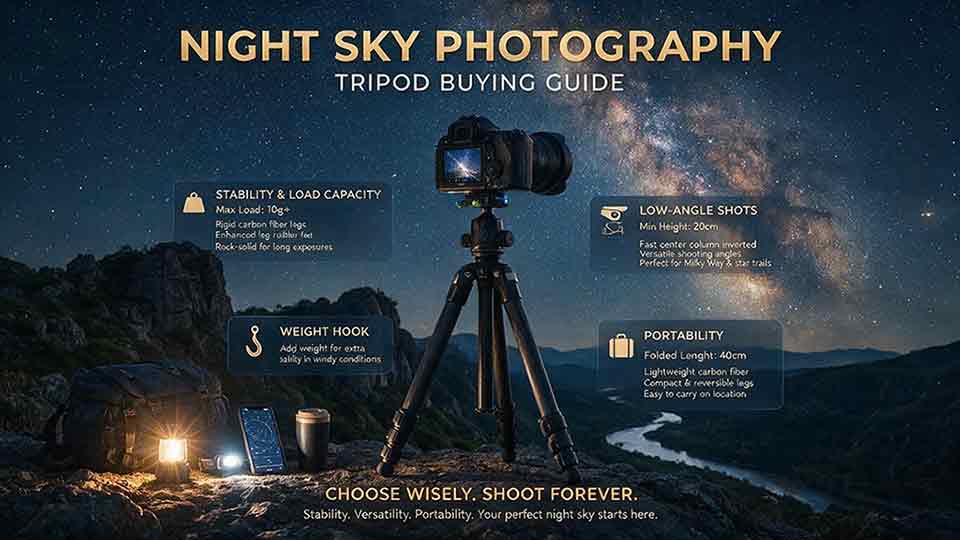
Tripod Buying Guide for Night Sky Photography
A tripod for night sky photography should be selected by stability, complete system load, working height, head security, terrain, wind exposure, and realistic carry weight rather than payload alone. This guide explains the difference between safely holding equipment and remaining steady during long exposures. It compares carbon fiber and aluminum, three-, four-, and five-section legs, center columns, twist and flip locks, ball and geared heads, leveling bases, quick-release systems, feet, and tracker-compatible platforms. Readers receive an illustrative complete-load calculation, a seven-question decision framework, six practical use scenarios, step-by-step setup guidance, troubleshooting, environmental maintenance advice, and a detailed buying checklist. The central recommendation is to choose the lightest tripod that remains dependable with the exact camera, lens, head, tracker, wind, and ground conditions in which it will actually be used.
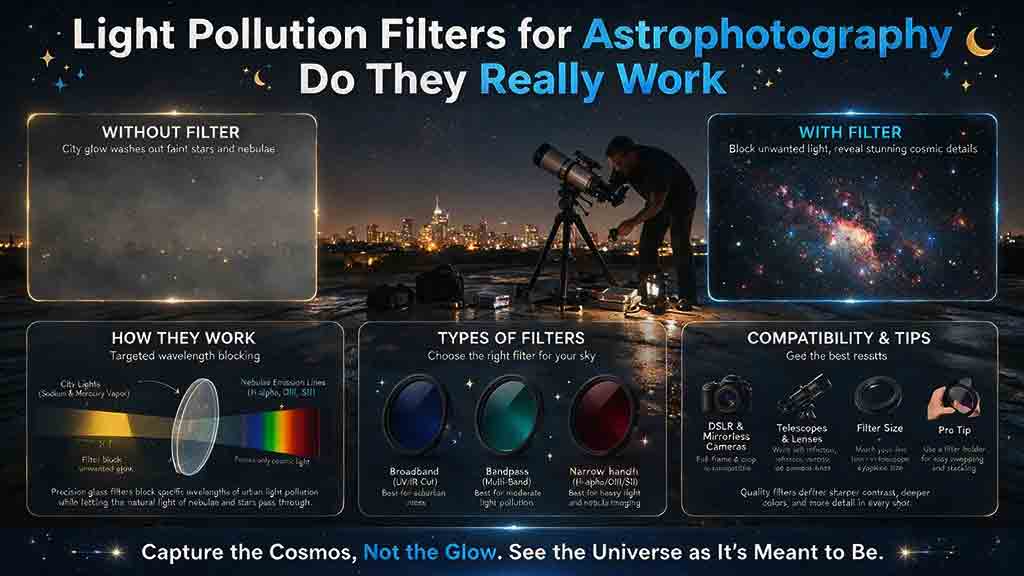
Light Pollution Filters for Astrophotography: Do They Really Work?
Light pollution filters can improve astrophotography, but their value depends on the target spectrum, local lighting, filter transmission curve, camera, and optical system. Dual-band and narrowband filters are most effective on emission nebulae because they isolate hydrogen-alpha, oxygen, and other narrow emission lines while rejecting much of the sky background. Broadband suppression filters offer smaller and less predictable gains on galaxies, reflection nebulae, star clusters, and Milky Way nightscapes, especially under broad-spectrum LED lighting. This guide compares filter categories, explains fast-optics passband shift, vignetting, focus changes, color casts, and halos, and provides an illustrative contrast and signal-to-noise calculation. Readers also receive a seven-question decision framework, matched A/B testing procedure, practical scenarios, troubleshooting, a complete buying checklist, and an essential warning that nighttime astrophotography filters are never safe solar filters.
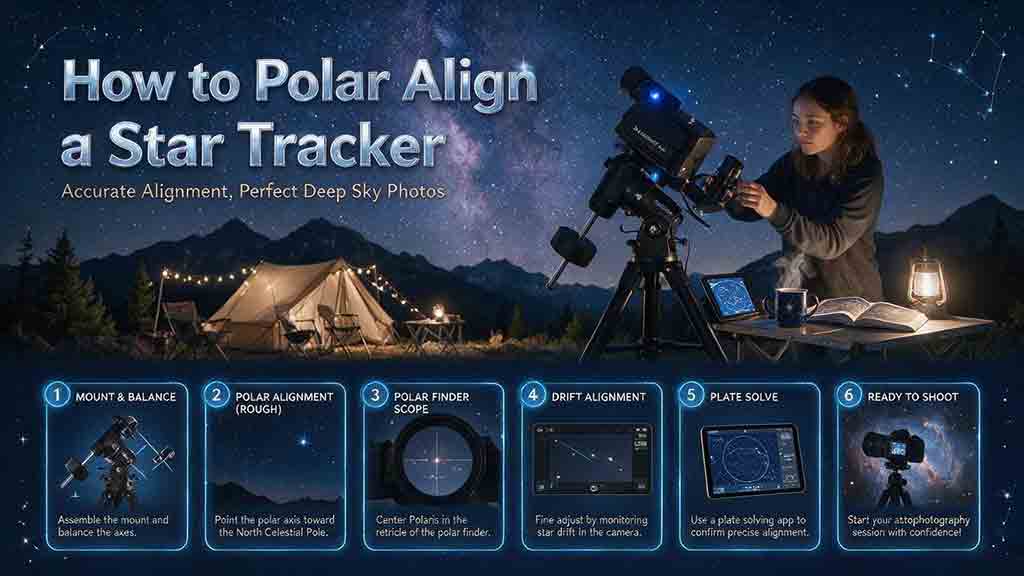
How to Polar Align a Star Tracker
Polar alignment points a star tracker’s right-ascension axis toward the north or south celestial pole so the mount can follow the apparent motion of the sky. This guide explains how to prepare and balance the tracker, identify true north or south, set the wedge near local latitude, and refine alignment with an optical polar scope, model-specific reticle app, electronic polar camera, plate-solving routine, or drift method. Separate Northern and Southern Hemisphere instructions explain why Polaris must be offset from the north celestial pole and how the faint Octans pattern is used in the south. Readers also receive a three-pass workflow, method-selection table, exposure-escalation test, practical scenarios, safety and setup checklists, common mistakes, polar-scope calibration test, and detailed troubleshooting guidance. The article distinguishes polar alignment from GoTo star alignment, balancing, plate solving, and autoguiding.
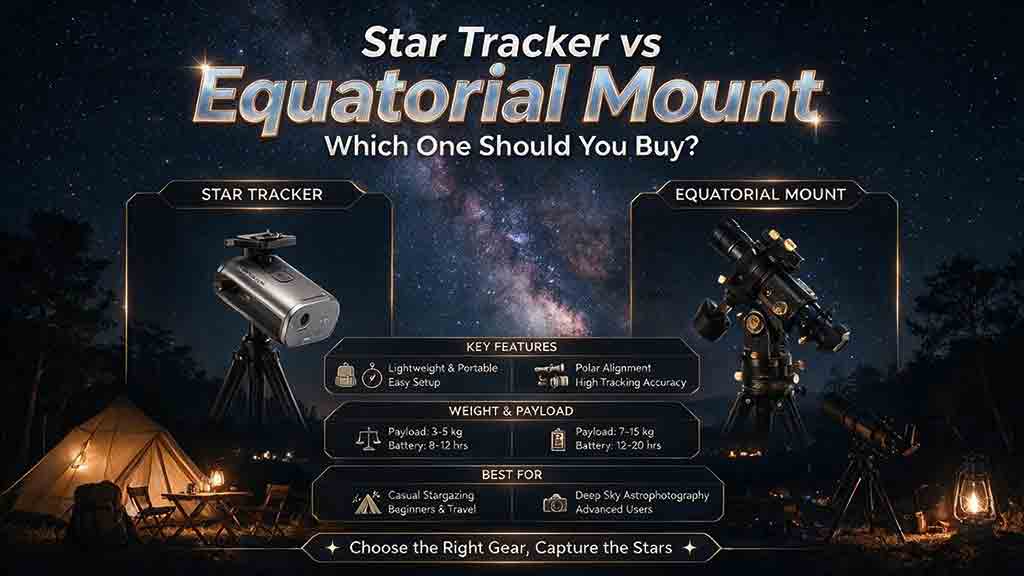
Star Tracker vs Equatorial Mount: Which One Should You Buy?
A star tracker is usually the better purchase for portable camera-lens astrophotography, while a full equatorial mount is better suited to telescopes, longer focal lengths, heavier accessories, dual-axis guiding, GoTo, plate solving, and automated imaging. This guide explains why the market also contains a middle category of dual-axis GoTo trackers, so product labels alone cannot determine the correct choice. It compares payload, torque, tracking consistency, guiding axes, periodic error, meridian behavior, transport, setup time, power, software, and complete ownership cost. Readers receive an illustrative torque calculation, a usable-integration calculation, a seven-step decision framework, six practical scenarios, troubleshooting tables, and a comprehensive buying checklist. The central recommendation is to choose the smallest system that reliably supports the real focal length, complete load, workflow, and upgrade plan.
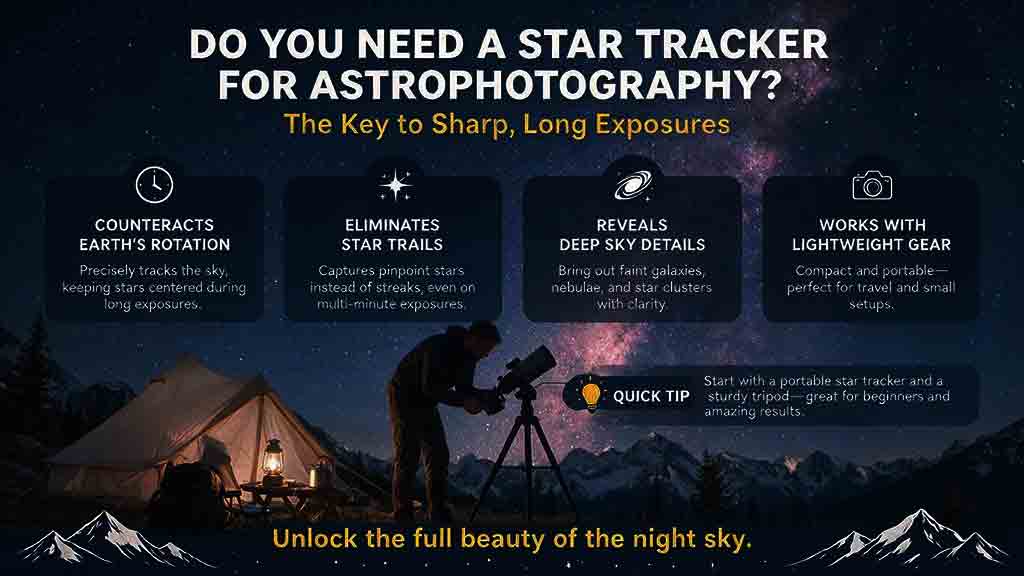
Do You Need a Star Tracker for Astrophotography?
A star tracker is not required for every kind of astrophotography. A fixed tripod remains the practical starting point for wide Milky Way landscapes, aurora, meteors, the Moon, planets, and intentional star trails. Tracking becomes valuable when star motion limits longer exposures, telephoto lenses, faint wide-field targets, lower ISO, or larger final output. This guide explains how trackers counter Earth’s apparent sky motion, how they differ from tripods and full equatorial mounts, and why payload ratings do not guarantee round stars. Readers receive an illustrative pixel-motion calculation, an exposure-testing method, target and focal-length decision tables, tracked-sky foreground workflows, polar-alignment and balance guidance, five practical scenarios, troubleshooting, and a complete setup checklist. The central recommendation is to buy a tracker only when it solves a documented limitation rather than treating it as mandatory equipment.