Cameras Lenses & Sensors
Explore 5 fascinating articles about cameras lenses & sensors
Explore cameras, lenses, and sensor technologies. Learn how to choose the right gear for capturing stunning night sky images.
All Articles (5)
Dedicated Astronomy Camera vs Regular Camera: What Is the Difference?
A dedicated astronomy camera is designed for telescope imaging through astronomy software and may provide regulated cooling, high-frame-rate readout, monochrome capture, filter-wheel integration, and FITS metadata. A regular DSLR or mirrorless camera is a self-contained general-purpose camera with a screen, battery, memory card, native lenses, autofocus, and daytime usefulness. This guide explains why neither category is universally better. It compares cooled deep-sky cameras, uncooled planetary cameras, guide cameras, monochrome and one-shot-color sensors, regular cameras, and specialized astrophotography DSLRs. Readers learn how cooling, dark current, H-alpha response, UV/IR filtering, sensor size, pixel scale, back focus, software, power, calibration, frame rate, and total system cost affect the decision. The article also includes calculation examples, use-case recommendations, a five-question selection process, a buying checklist, common mistakes, troubleshooting, and practical next steps.
How to Choose a Camera for Astrophotography
Choosing an astrophotography camera starts with the target, optical system, and workflow rather than megapixels or sensor size alone. This guide compares mirrorless and DSLR bodies, cooled one-shot-color cameras, cooled monochrome cameras, planetary cameras, and astronomy-modified models. Readers learn how sensor dimensions affect field of view, how pixel size and focal length determine image scale, and how cooling, quantum efficiency, read noise, full-well capacity, dynamic range, and frame rate should be interpreted. It also provides a color-versus-monochrome comparison, telescope compatibility and back-focus checks, software and driver requirements, a total-system-cost framework, five practical scenarios, troubleshooting, and a complete purchase checklist. The central recommendation is to choose the camera that fits the target, corrected image circle, mount, software, power system, processing workflow, and complete budget.
Best Focal Lengths for Milky Way Photography
For most untracked Milky Way landscapes, a 14–24mm full-frame-equivalent view offers the best balance of sky coverage, galactic scale, foreground context, and shutter-time tolerance. Wider 12–16mm views suit dramatic foregrounds and a large Milky Way arch, while 28–35mm makes the galactic center more prominent. Focal lengths of 40–50mm or longer are better for panoramas, stacking, or tracked high-detail images. This guide converts the recommendations for full-frame, 1.5× APS-C, 1.6× Canon APS-C, and Micro Four Thirds cameras. It explains shutter-time tradeoffs, crop-factor calculations, aperture and corner-performance limits, prime-versus-zoom choices, panorama planning, and tracker use. Readers also receive a three-question lens-selection method, real-world scenarios, a step-by-step lens test, a buying checklist, common mistakes, troubleshooting guidance, and practical recommendations without unsupported “best lens” claims.
DSLR vs Mirrorless Camera for Astrophotography
Mirrorless cameras are usually the more flexible choice for a new astrophotography system, but a capable DSLR can remain the better value when the photographer already owns suitable lenses, needs strong battery endurance, or can buy a proven used body inexpensively. This guide separates camera architecture from sensor performance and compares focusing, shutter vibration, battery use, body weight, lens ecosystems, telescope spacing, electronic shutters, stabilization, software support, modification, and complete switching cost. It also explains which format fits Milky Way landscapes, tracked deep-sky work, lunar and planetary imaging, star trails, and travel. Readers receive a keep-adapt-switch decision framework, a hypothetical transition-cost calculation, five practical scenarios, troubleshooting guidance, and a detailed buying checklist. The main recommendation is to change systems only when mirrorless solves a documented workflow limitation.
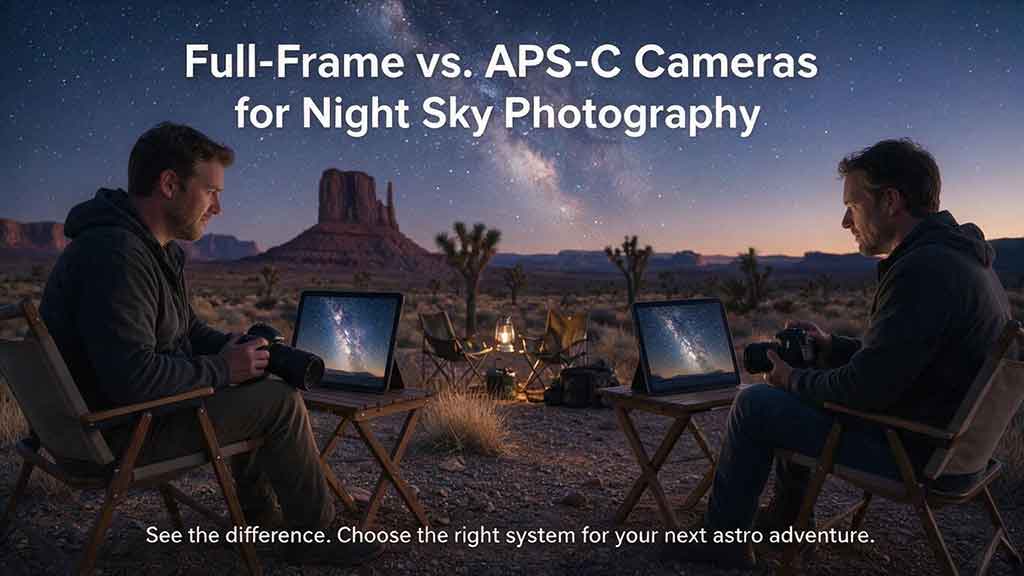
Full-Frame vs APS-C Cameras for Night Sky Photography
Full-frame cameras usually provide the easiest route to wide nightscapes and strong equal-output image quality, while APS-C cameras often create a lighter, less expensive, and more telescope-friendly system. This guide separates two commonly confused comparisons: using the same lens and position versus matching the final field of view. It explains crop factor, field of view, total sensor area, pixel density, image scale, untracked star movement, lens requirements, tracker payload, telescope image circles, filter sizes, and complete system cost. Readers receive original field-of-view and sensor-diagonal calculations, a target-based decision matrix, five practical scenarios, troubleshooting guidance, and a detailed buying checklist. The central recommendation is to choose full frame only when the complete optical and support system can use the wider sensor, and to choose APS-C when portability, budget, sampling, or optical coverage provides greater practical value.